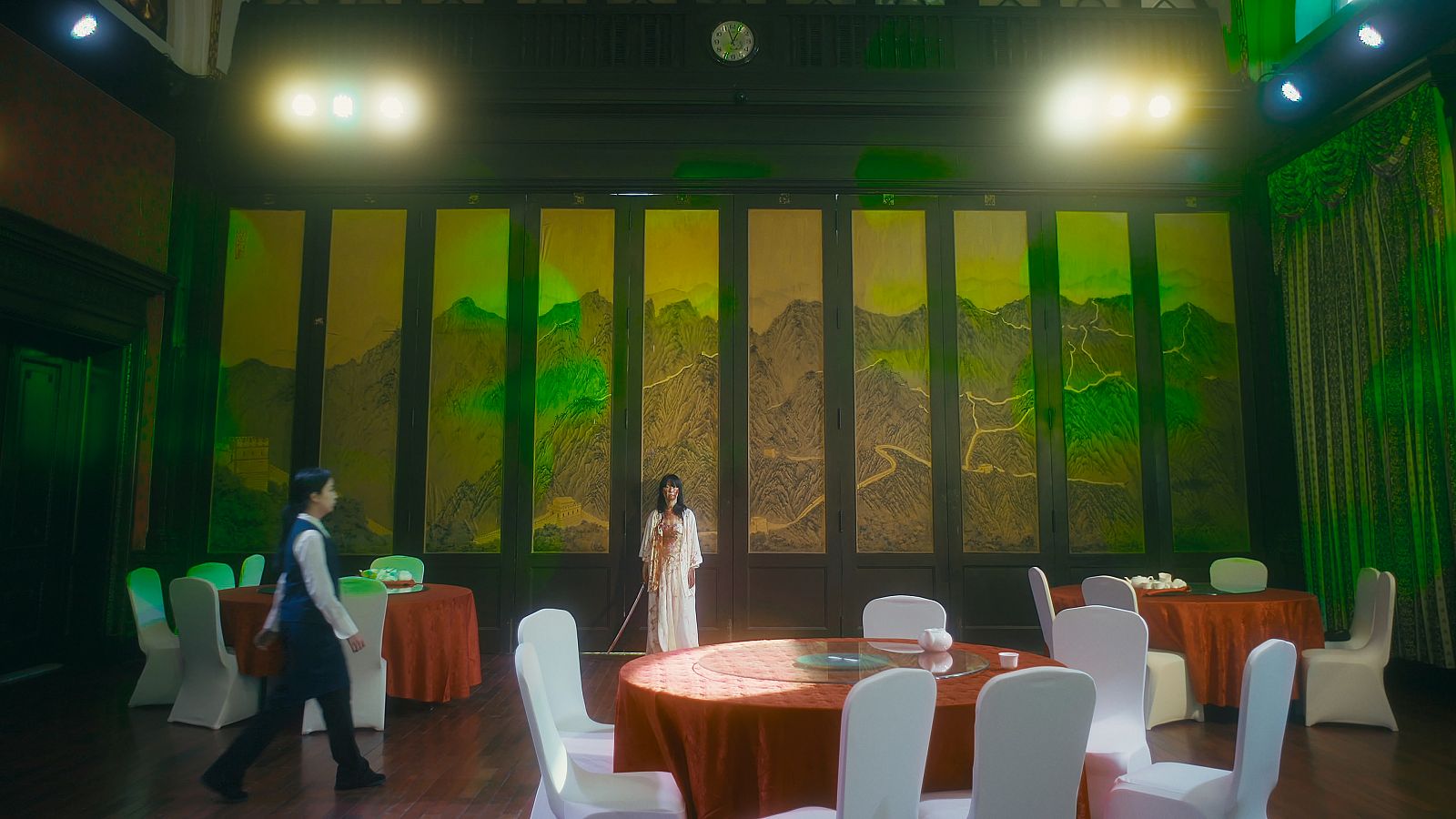
Mooni Perry,EL, 2025, single-channel video, color, sound, 34 min. Commissioned by National Museum of Modern and Contemporary Art, Korea and MACA Art Center.
EL
2025
Single-channel video, color, sound
34 min
Commissioned by National Museum of Modern and Contemporary Art, Korea and MACA Art Center
EL (2025) is a short fiction film grounded in Mooni Perry's ongoing interest in East Asian history and identity, developed through on-site research and filming in Northeast China. Built on research into Manchuria during the Japanese colonial occupation, the project centers on the stories of women from Joseon who migrated there by force or choice but were ultimately unable to return to their homeland. Shot at the Liaoning Hotel (formerly the Yamato Hotel) in Shenyang, China—a site closely tied to the establishment of Manchukuo—the film interweaves the realities and dreams of its protagonists, evoking the layered past and present of people from Joseon in Manchuria.
The film does not recount history directly, nor is it a period piece. Instead, it moves through the densely layered temporality of the Liaoning Hotel, allowing unresolved memories to surface in dailogues, silences, and fragmented dreams. These moments evoke the spectral traces of Josoen women's lives in Manchuria—not to restore a historical record, but to stay with what cannot be neatly narrated. The question that lingers is not what happened, but rather: What became of the woman who departed from Joseon?
Blurring dream and reality, past and present, the hotel becomes less a site to be mapped than one to be felt—an untraceable geography of absence and haunted persistence.
Based in Berlin, Mooni Perry explores the allegories and discourses shaped by social and cultural contexts. Over the past several years, her video works have drawn from research into feminism, Taoism and tradition, and East Asian futurism, addressing broader questions of Asian identity. Since 2021, Mooni Perry has also co-run the platform AFSAR with international colleagues to share research and creative activities.